
 Available in US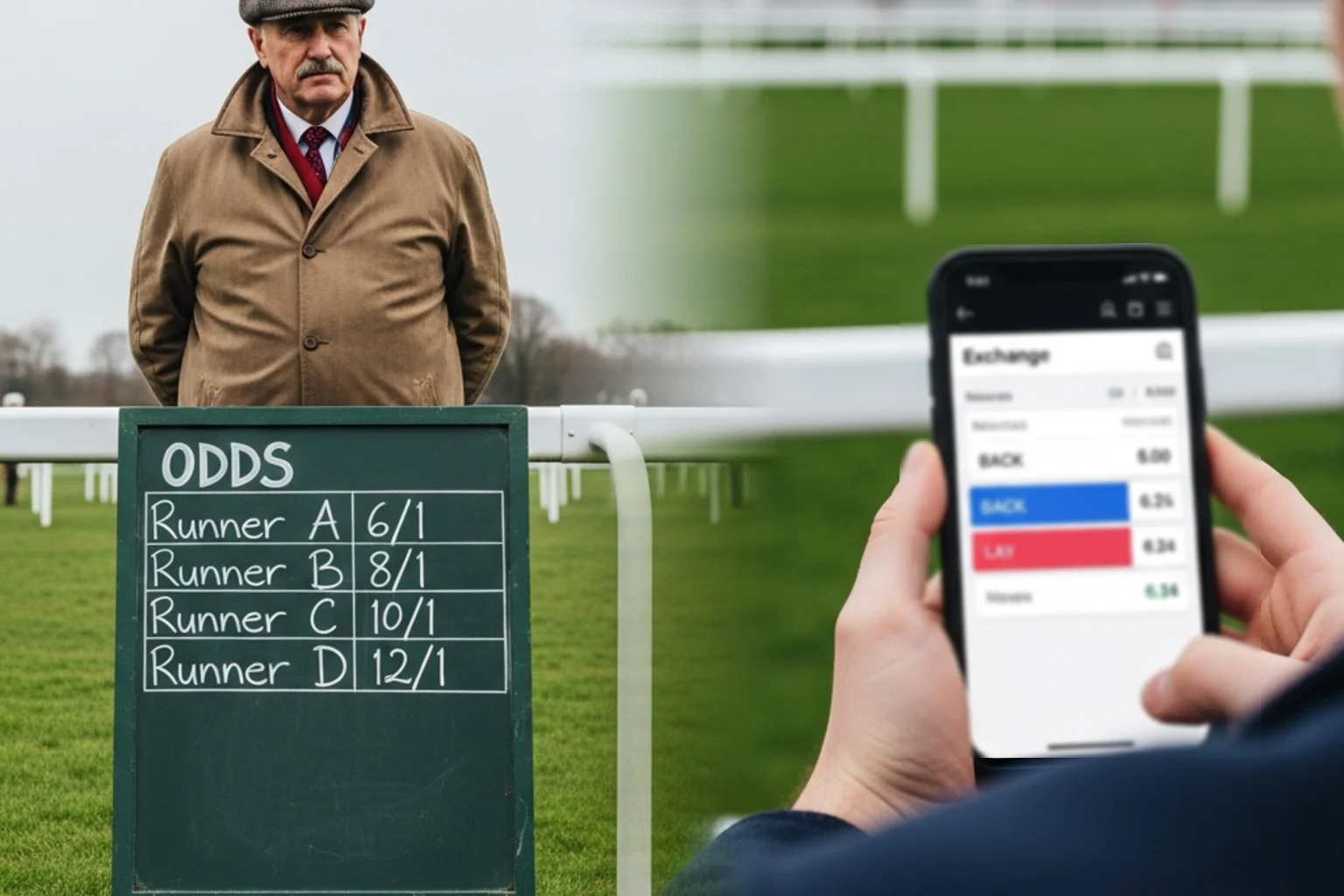
- How Betting Exchanges Work for Ante Post
- How Bookmakers Price Ante Post Markets
- Odds Comparison: Exchange vs Bookmaker
- Commission vs Margin: True Cost of Betting
- How Non-Runners Are Handled Differently
- The Lay Bet Advantage in Ante Post
- Liquidity: When Exchange Volumes Are Too Thin
- Bookmaker or Exchange? Matching Your Style
- The Hybrid Approach: Using Both
Ante-post betting exchanges and bookmakers offer the same product — an early bet on a horse to win a future race — but the mechanics underneath are fundamentally different. The non-runner rules diverge. The cost structures diverge. The tools available to manage your position diverge. Choosing between them, or choosing to use both, is not a question of preference. It is a strategic decision that affects your expected return on every ante-post bet you place. British horse racing betting generated £766.7 million in remote gross gambling yield in 2024-25, and how much of that yield the house extracts from your bets depends, in large part, on which platform you choose.
How Betting Exchanges Work for Ante Post
A betting exchange is a peer-to-peer marketplace. When you back a horse on Betfair or Smarkets, you are not betting against the company — you are betting against another punter who has offered to lay that horse. The exchange takes no position on the outcome. It simply matches backers with layers and charges a commission on winning bets.
In ante-post markets, this structure creates several distinctive features. First, you can both back and lay. If you backed a horse at 20/1 in November and it has shortened to 6/1 by February, you can lay it on the exchange at the shorter price, locking in a guaranteed profit regardless of whether the horse wins. This trading capability does not exist with a bookmaker unless cash-out is offered — and cash-out, as discussed below, comes with its own costs.
Second, exchange ante-post markets are continuous. Prices update in real time as bets are matched, and you can see the available back and lay prices at every moment. This transparency is a double-edged sword: you can observe the flow of money into and out of a market, but so can everyone else. There are no private prices, no whispered odds — only the public ladder of bets waiting to be matched.
Third — and this is the critical difference for ante-post — non-runners on exchanges are voided. If you back a horse in an ante-post exchange market and it does not run, your stake is returned. This is the polar opposite of the bookmaker model, where the stake is lost. The exchange treats a non-runner as a null event: no outcome occurred, so no bet is settled. For ante-post bettors haunted by the spectre of losing money on a horse that never reached the start, this distinction alone can justify using an exchange.
There is a nuance to the voiding rule that matters. Betfair applies a “material runner” assessment when a horse dies or is formally scratched from an ante-post race. If the horse is deemed material — roughly, a selection with a reduction factor of 2.5% or more — Betfair may take specific action on the market. For non-material runners, the voiding is clean and automatic. For material runners, the process involves assessment by Betfair’s trading team, and the outcome may include a full market void and reload. This edge case is rare but worth understanding if you are betting at significant stakes on exchange ante-post markets.
How Bookmakers Price Ante Post Markets
A bookmaker prices an ante-post market by assessing the probability of each horse winning, then adding a margin — the overround — to ensure profitability regardless of the outcome. In a perfectly calibrated market, the implied probabilities of all runners would sum to 100%. In practice, they sum to 110%, 115%, or higher, with the excess representing the bookmaker’s profit margin.
Ante-post markets typically carry higher overrounds than day-of-race markets. The reason is uncertainty: the more distant the race, the less confident the bookmaker is in the pricing, and the wider the margin it needs to protect against mispricings. An ante-post Gold Cup market priced up in October might have an overround of 130% or more. By race week, as the field is confirmed and the market has traded extensively, the overround may have compressed to 115%. The early bettor is paying a higher margin for the privilege of bigger odds.
Bookmakers also adjust their ante-post markets actively, cutting prices on horses that are being backed and drifting those that are not. Unlike exchanges, where the price reflects the collective opinion of participants, bookmaker prices reflect a combination of statistical assessment, liability management, and competitive positioning. A bookmaker may shorten a horse not because it believes the horse is more likely to win, but because too much money has come in and the liability needs to be managed.
Best Odds Guaranteed — the promotion where bookmakers pay out at the higher of the price you took or the starting price — does not apply to ante-post bets. This is explicitly excluded in the terms of virtually every UK-licensed operator. The price you take at the time of your ante-post bet is the price you receive, full stop.
Odds Comparison: Exchange vs Bookmaker
Exchange odds are, structurally, closer to the true probability than bookmaker odds, because the exchange has no margin built into the price. The “margin” on an exchange comes from the commission charged on winnings, which is separate from the odds themselves. A horse available to back at 10.0 (9/1) on an exchange is being priced at an implied probability of 10%. The same horse at 8/1 with a bookmaker has an implied probability of 11.1% — the extra 1.1% is margin.
In ante-post markets, the gap between exchange and bookmaker prices is often wider than on race-day markets. The average UK horse race generates roughly £500,000 in matched volume on Betfair, but ante-post markets months before the race are much thinner — sometimes only tens of thousands of pounds. Lower liquidity means wider spreads between back and lay prices, and it means that the exchange price may not always be available at the volume you want.
Bookmaker ante-post prices, by contrast, are available for the stake you want (within account limits) at the price displayed. There is no need to wait for a lay counterparty. The trade-off is clear: the exchange offers a structurally better price but less certainty of execution; the bookmaker offers guaranteed execution at a structurally less favourable price.
In practice, the optimal approach is to compare prices across both channels before placing a bet. A horse at 12/1 with a bookmaker and 14.0 (13/1) on the exchange is a straightforward comparison: the exchange offers better value, and if there is sufficient liquidity to be matched, it is the superior bet. But if the exchange back price is 14.0 with only £50 available and you want to stake £200, the bookmaker’s guaranteed 12/1 may be the practical choice.
Commission vs Margin: True Cost of Betting
The cost of an ante-post bet is not the stake — that is the capital at risk. The cost is the portion of your expected return that is extracted by the intermediary. On a bookmaker, this cost is the overround margin, embedded invisibly in the odds. On an exchange, it is the commission on winning bets, charged explicitly.
Smarkets charges 2% commission on net winnings. Betfair’s standard rate is 5%, though long-standing customers may qualify for lower rates through their discount structure. A £100 winning bet at 10/1 on Smarkets returns £1,100 gross minus 2% commission on the £1,000 profit, yielding £1,080. The same bet with a bookmaker at 9/1 — reflecting the built-in margin — returns £1,000. The exchange bettor pockets an extra £80 for the same outcome.
Over a season of ante-post betting, the cumulative difference is material. If you place thirty ante-post bets and win three at an average of 10/1, the extra value from exchange pricing and lower commission can amount to several hundred pounds compared to the same bets placed at bookmaker odds. The caveat is that exchange ante-post bets void on non-runners (returning the stake), while bookmaker ante-post bets lose the stake — so the exchange’s cost advantage is partially offset by the bookmaker’s occasionally superior promotional offerings like NRNB.
One further consideration: exchange commission is charged only on net profit within a market. If you back and lay the same horse — hedging your position — the commission is charged on the net gain, not on each individual leg. This makes hedging on exchanges relatively cheap. On a bookmaker, there is no comparable mechanism — the margin is embedded in the odds of every bet, regardless of whether you later cash out or hold.
How Non-Runners Are Handled Differently
This is the single most consequential rule difference between exchanges and bookmakers for ante-post betting. On a bookmaker, a non-runner in an ante-post market means your stake is lost. On an exchange, it means your bet is voided and your stake is returned.
The implications ripple through every ante-post decision. On a bookmaker, you must actively consider the non-runner probability when assessing a bet’s value. A horse at 10/1 that you estimate has a 15% chance of not running has an effective ante-post price that is materially worse than 10/1 — because 15% of the time, you lose your entire stake without a race being run. On an exchange, the non-runner probability is irrelevant to the ante-post calculation, because a non-runner returns your capital.
There is a subtlety. Exchange ante-post bets are voided on non-runners, but this only applies to bets placed in the ante-post market. Once the market transitions to the day-of-race phase — typically when final declarations are made — exchange bets are no longer ante-post and are subject to reduction factors if a horse withdraws. The transition is automatic, but punters who hold long-standing exchange positions should be aware that their bet’s non-runner treatment changes at the declaration stage.
Online horse racing betting turnover fell by £1.6 billion over two years, and the non-runner frustration is one of several factors cited by industry figures for the decline. The exchange model — which removes the non-runner sting entirely for ante-post bets — arguably offers a more punter-friendly structure. But it has not captured the majority of ante-post volume, partly because the bookmaker model is simpler, more widely understood, and supported by NRNB promotions that the exchanges do not offer.
The Lay Bet Advantage in Ante Post
The ability to lay a horse — to bet against it winning — is the exchange’s most powerful feature for ante-post bettors. Laying enables hedging, trading, and position management that are impossible on a bookmaker platform without cash-out.
The classic ante-post hedge works as follows. You back a horse at 20/1 with a £50 stake (potential return: £1,050). Months later, the horse has won a trial and shortened to 6/1. You lay the horse on the exchange at 6/1 for a calculated stake — roughly £150 — which means that if the horse wins, your lay liability (£750) is covered by your bookmaker payout (£1,050), leaving a guaranteed profit. If the horse loses, your original stake is lost but you keep the lay stake minus the exchange commission. The net position is a guaranteed profit regardless of the race outcome.
The BHA’s data showed that average turnover at Premier fixtures — where the biggest ante-post markets trade — rose 1.1% even as overall turnover declined 4.3%. The concentration of money at the top end means that exchange ante-post markets on major races — Cheltenham, Aintree, Royal Ascot — are liquid enough to support hedging at meaningful stakes. For midweek races or lower-tier events, exchange liquidity thins out and hedging becomes impractical.
Partial hedging — laying a portion of your exposure rather than the full amount — is another tool. If you are confident but not certain, laying half your position locks in a partial profit while maintaining upside. The flexibility to calibrate your exposure in real time, responding to new information as it emerges, is the exchange’s core strategic advantage over the bookmaker model.
Liquidity: When Exchange Volumes Are Too Thin
Exchange ante-post markets are not always liquid enough to support the bets you want to place. The average UK horse race generates around £500,000 in total matched volume on Betfair, but that figure covers all betting — pre-race and in-play. Ante-post markets, especially those priced up months in advance, may have only a few thousand pounds available at the displayed prices.
Low liquidity creates two problems. First, you may not be able to get matched at the price you want. A horse showing 14.0 to back on the exchange may have only £20 available at that price, with the next available price being 12.0. If your intended stake is £100, you either accept a worse price or wait for more liquidity to arrive — which may never happen.
Second, low liquidity makes hedging unreliable. If you back a horse ante-post on the exchange and later want to lay it to lock in a profit, the lay side of the market may be equally thin. You might need to offer a lay price that is wider than the current back price, effectively paying a liquidity premium to exit your position.
The liquidity problem is least severe for the biggest races — Gold Cup, Champion Hurdle, Grand National — where ante-post exchange volumes can run into hundreds of thousands of pounds. It is most severe for midcard handicaps, minor meetings, and races more than six months away. As a general rule, exchange ante-post works best for high-profile races in the three months before the event. For everything else, the bookmaker may offer a more practical, more reliable route.
One technique for managing thin liquidity is to place your exchange order at the price you want and leave it in the market. Exchange orders do not expire; they sit in the book until matched or cancelled. A back order at 16.0 on a Gold Cup contender might not be matched immediately, but if the horse drifts to that price after a disappointing piece of news, your order fills automatically. This patient approach — setting the price you are willing to pay and waiting — is the opposite of the bookmaker model where you accept or reject the displayed price. It requires tolerance for uncertainty but rewards discipline with better average entry prices over a season.
Bookmaker or Exchange? Matching Your Style
The choice between exchange and bookmaker is not binary — it is contextual. Different situations call for different platforms, and the ante-post bettor who uses only one is leaving value on the table.
Use a bookmaker when NRNB is available and you want the simplest possible bet. The NRNB concession eliminates the non-runner risk, which is the exchange’s primary advantage. If the bookmaker price is competitive and NRNB is active, the bookmaker bet is the better option — you get early odds, non-runner protection, and guaranteed execution at the price displayed.
Use an exchange when NRNB is not available and the non-runner risk is a concern. The exchange voids non-runners, effectively providing the same protection as NRNB but as a structural feature rather than a promotional one. Also use an exchange when you plan to hedge or trade your position — the lay function makes this possible in a way that bookmaker cash-out cannot replicate with the same precision or cost efficiency.
Grainne Hurst, CEO of the Betting and Gaming Council, has noted that regulated betting continues to fund British racing through record Levy contributions — “for the fourth year running,” she observed, “contributions have increased to record levels. This demonstrates the growing, long-term investment regulated betting provides British horse racing.” That investment comes from both bookmaker and exchange revenue. Using either channel within the regulated market supports the sport. Using neither — or worse, using unlicensed operators — does not.
The Hybrid Approach: Using Both
The most effective ante-post strategy combines both platforms. The typical workflow: identify a horse you want to back ante-post. Check the bookmaker price and the exchange price. If the bookmaker offers NRNB and the price is competitive, back with the bookmaker. If the exchange offers a materially better price and NRNB is not yet available, back on the exchange (where a non-runner would return your stake).
As the race approaches: if the horse has shortened and you want to lock in profit, lay on the exchange regardless of where the original bet was placed. A bookmaker bet at 16/1 can be hedged by laying on Betfair at 6/1 — the platforms do not need to be the same. The hedge calculation works on the odds, not the operator.
If the horse drifts — the price lengthens rather than shortens — you may want to add to your position. Here the choice of platform depends on what has changed. If the drift reflects genuine bad news (a setback, a poor trial), adding is probably unwise regardless of platform. If the drift reflects market noise (a rival shortening, a media-driven overreaction), adding at a now-longer price on the exchange preserves the non-runner void protection while lowering your average entry price.
The hybrid approach requires managing two or three accounts, tracking positions across platforms, and executing hedges that span different operators. It is not for the casual punter. But for the ante-post bettor who treats this as a disciplined, season-long practice, the combination of bookmaker NRNB, exchange non-runner voiding, and exchange lay hedging provides a toolkit that neither platform offers alone.
A simple record-keeping system makes the hybrid manageable. Track each position in a spreadsheet: date, horse, race, platform, odds, stake, NRNB status, current market price, and any hedge legs. Update after each trial result or market move. At a glance, you should be able to see your total exposure, your potential profit, and whether any position needs adjustment. The extra administrative effort is the cost of a structural edge. For those willing to pay it, the returns follow.
Betting Exchanges vs Bookmakers for Ante Post Bets — More on this topic at ante post betting.
See also Non-Runner No Bet (NRNB).
