
 Available in US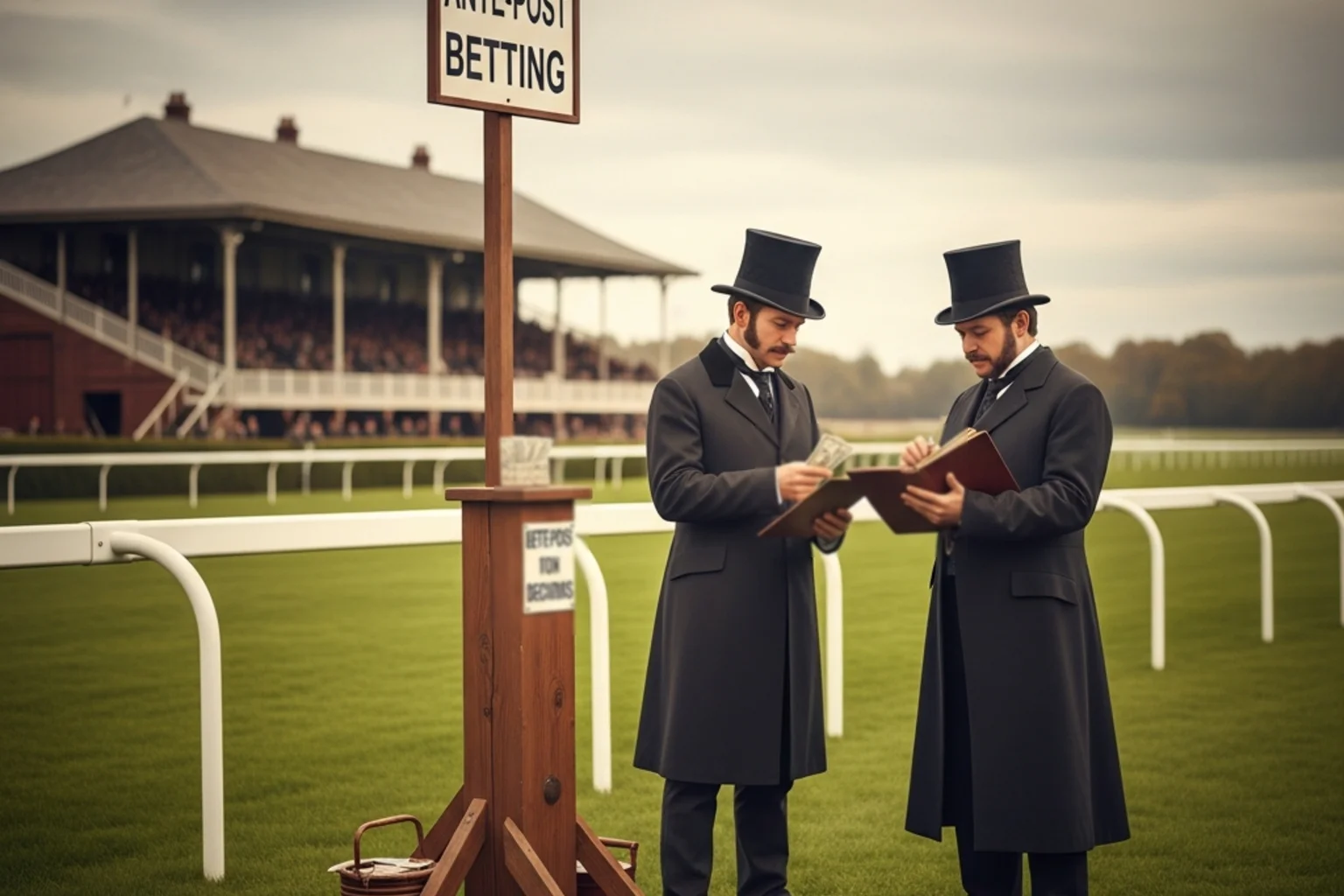
Ante-post betting has been part of British horse racing for longer than bookmakers have had shops, longer than radio carried race commentary, and longer than most of the racecourses now hosting the sport. The practice of wagering on a race well before it takes place did not arrive with the internet or even with legalised betting shops. It grew from the physical infrastructure of nineteenth-century racecourses — a wooden stake driven into the ground, a crowd of punters queueing in their carriages, and a bookmaker chalking prices on a board. The language has survived. The mechanics have transformed completely. Today, British horse racing generates £766.7 million in gross gambling yield from remote betting alone, and a significant slice of that money flows through ante-post markets that trace their lineage to a wooden post in a muddy field.
The Betting Post
The word “post” in ante-post does not derive from the Latin post meaning “after.” It comes from the Betting Post — a physical stake or sign-post that was fixed at a designated point on the racecourse to signal where official on-course betting began. Bettors would gather at the post, sometimes still in their carriages, to place wagers with the bookmakers assembled there. A bet placed before reaching the post — before the official market opened — was an ante-post bet. The terminology is recorded in racing literature from the mid-nineteenth century, though the practice almost certainly predates the formal naming.
These early ante-post bets were informal affairs. A punter might approach a bookmaker weeks before a race and agree a price, with the terms scribbled in a ledger. There was no regulatory framework, no standardised rules, and no recourse if the bookmaker reneged or the horse did not run. The concept of a lost stake on a non-runner was baked into the arrangement from the start: the bookmaker was offering a generous price precisely because the outcome was uncertain, the horse might not run, and the money was committed long before the race took place.
By the 1860s, when the National Hunt Chase was first held and Cheltenham was establishing itself as a permanent fixture, ante-post betting was already a recognisable feature of the racing calendar. The great races of the era — the Derby, the St Leger, the Grand National — attracted ante-post interest months in advance, with prices circulated through word of mouth and the racing press.
Turf Accountants
Before 1961, off-course cash betting in Britain was illegal. But it happened everywhere. The turf accountant — a euphemism for an illegal street bookmaker — operated in pubs, factories, and street corners, taking bets on credit or through intermediaries. Ante-post betting thrived in this grey economy because it suited the logistical constraints. A punter could place a bet days or weeks before the race, settle up after the result, and avoid the need for a physical transaction on the day.
For punters who could not travel to the racecourse, the postal system became the primary channel. Bets were literally posted — written on a slip and mailed to the bookmaker — and the term “ante-post” gained a double resonance. The bookmaker would confirm the bet by return mail, and the settlement followed the same channel. This postal model worked adequately for long-range bets but was slow and prone to disputes. Lost letters, denied bets, and contested terms were routine irritations that only formal regulation would eventually resolve.
National newspapers played a crucial role in the ante-post ecosystem. Prices for the major races were published in the racing pages, giving punters across the country access to market information for the first time. Bookmakers priced up the Classics and the Grand National in the press partly for publicity — a horse quoted at 33/1 for the Derby generated column inches and interest — and partly to gauge market sentiment before committing to a position.
1961: Off-Course Betting
The Betting and Gaming Act 1961 legalised off-course betting shops in Britain, transforming the landscape overnight. For the first time, punters could walk into a licensed premises and place a legal cash bet. The Act also established the Horserace Betting Levy Board, which would collect a mandatory contribution from bookmakers to fund the racing industry — a mechanism that continues to this day, with the Levy reaching a record £108.9 million in the 2024-25 financial year.
Legalisation formalised ante-post betting. Bookmakers displayed ante-post prices on boards in their shops, and the rules — non-runners mean lost stakes, bets void if the race is abandoned — were codified under Tattersalls’ Committee oversight. The casual pub arrangement of the turf accountant era gave way to a regulated market with standardised terms. Punters gained legal protections, and bookmakers gained a legitimate business model.
The decades following legalisation saw the betting shop become a fixture of every British high street. Ante-post boards for the Grand National, the Derby, and the Cheltenham Gold Cup were displayed prominently in shop windows, drawing casual punters into the habit of backing horses weeks in advance. The social dimension — discussing ante-post fancies with fellow regulars in the shop — became part of the sport’s culture in a way that persists today, even as the physical betting shop has given ground to online platforms.
The Digital Revolution
The launch of Betfair in 2000 marked the single most disruptive event in ante-post betting since legalisation. The betting exchange allowed punters to bet against each other rather than against a bookmaker, and critically, it introduced the lay bet — the ability to bet on a horse not to win. For ante-post bettors, this was transformative. A horse backed at 20/1 in November could be laid at 6/1 in February, locking in a profit regardless of the race result. Hedging, previously available only to professional layers, became accessible to anyone with an internet connection.
Online bookmakers followed rapidly. By the mid-2000s, ante-post markets were available on every major operator’s website, with odds updated in real time and a depth of market that the betting shop board could never match. Mobile betting arrived in the 2010s and accelerated the trend. Over 80% of bets on the 2024 Cheltenham Festival were placed on mobile devices, according to data from Flutter Entertainment. The ante-post bet that once required a letter to a turf accountant now requires three taps on a phone screen.
The digital era also brought comparison tools. Sites like Oddschecker aggregate ante-post prices across dozens of bookmakers, making it trivial for punters to identify the best available odds. This price transparency has compressed margins and made the ante-post market more efficient — good for the informed bettor, less good for the bookmaker hoping to exploit price ignorance.
Ante Post in the 2020s
The 2020s have added a new chapter to the story. The Covid-19 pandemic suspended racing entirely in spring 2020, voiding thousands of ante-post bets and raising questions about the resilience of long-range betting markets. Racing returned within months, but the experience left a mark — NRNB offers became more prominent as bookmakers sought to rebuild punter confidence in ante-post products.
Regulatory change has reshaped the environment further. The Gambling Act review, affordability checks, and the introduction of a statutory levy for research and treatment of gambling harms have all altered the economics of British betting. Turnover on horse racing has fallen year-on-year since 2022, though the premier fixtures — where ante-post betting is most concentrated — have proven more resilient than everyday racing.
The next frontier is likely to involve artificial intelligence and algorithmic pricing. Bookmakers already use machine learning to set ante-post odds, and punters are increasingly using data tools to identify value. The gap between the wooden betting post of the 1860s and an AI-generated odds model is roughly a century and a half of continuous innovation, but the core proposition has not changed: back a horse before the market moves, accept the risk, and hope the price you locked in turns out to be a bargain.
History of Ante Post Betting — More on this topic at ante post betting.
See also Trainer Records in Ante Post Races.
