
 Available in US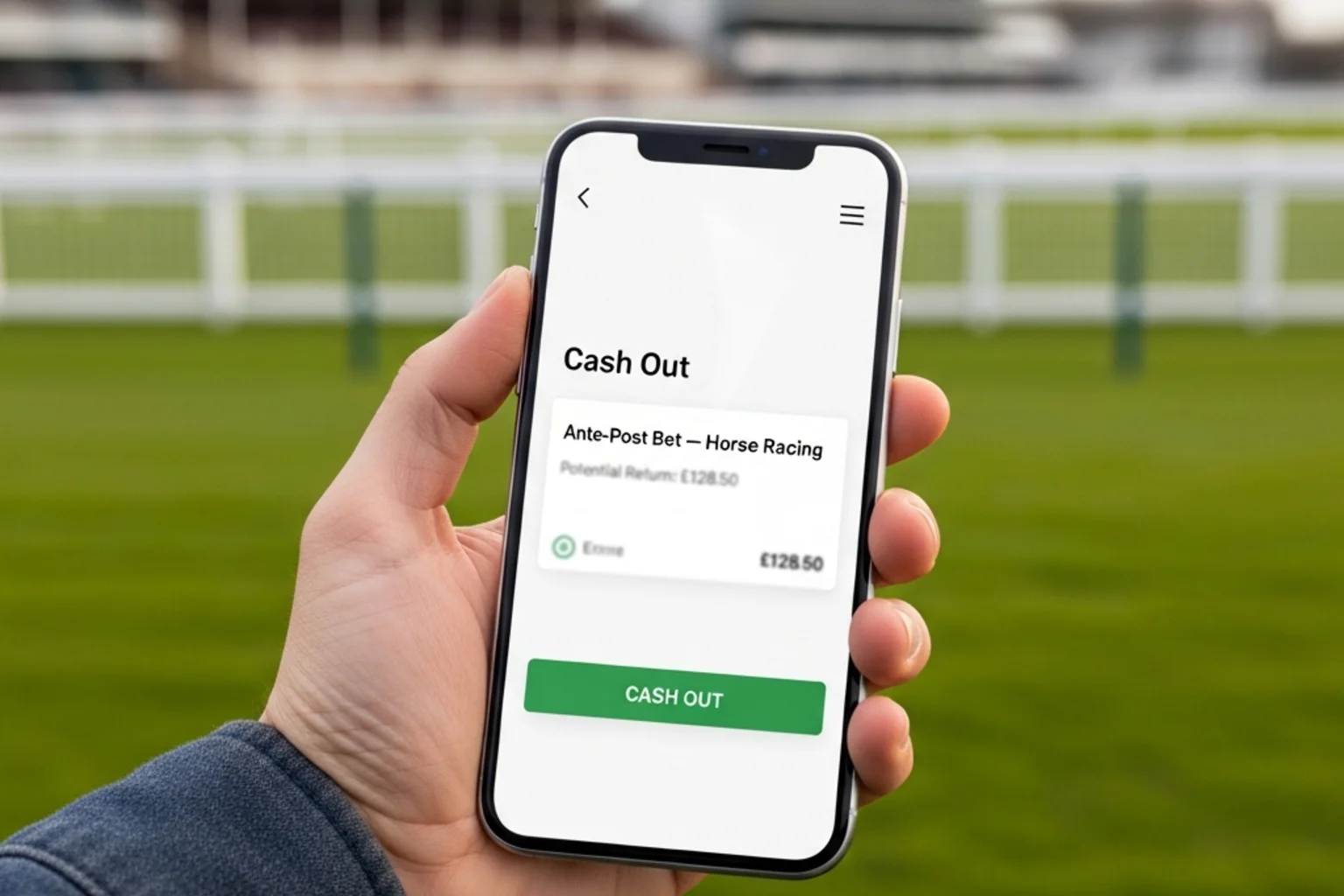
You backed a horse at 20/1 for the Cheltenham Gold Cup in October. By February, it has won two trials and the price has collapsed to 5/1. Your bet is sitting on a significant paper profit. The question every ante-post bettor reaches sooner or later: can you cash out? The answer is complicated. Some bookmakers offer it, some do not. Exchanges provide an alternative route through lay bets. And knowing when to take the money — versus when to let it ride — is a decision that has nothing to do with the cash-out button and everything to do with how you evaluate risk.
How Cash Out Works on Ante Post
Cash out, in its simplest form, is a bookmaker offering to settle your bet early at a price that reflects the current market. If your horse has shortened, the cash-out value will be higher than your original stake — the bookmaker is buying back the risk it no longer wants to carry. If the horse has drifted, the cash-out value will be lower, potentially much lower. The bookmaker calculates the offer using the current odds, factoring in its own margin. That margin is the catch: cash-out values are never as generous as the theoretical value of the bet, because the bookmaker keeps a slice for itself.
For ante-post bets specifically, cash out is less widely available than for day-of-race wagers. The reason is liquidity. A bookmaker offering cash out on a bet placed months in advance is committing to a price in a market that may have very little trading volume. The further from the race, the less confident the bookmaker is in the current price, and the less likely it is to offer a cash-out option. According to the BHA’s 2025 Racing Report, average turnover at Premier fixtures rose 1.1% year-on-year, which means the biggest race markets are deep enough to support cash-out mechanics. But for smaller ante-post markets, the feature often disappears entirely.
Which Bookmakers Offer It
Policies vary and change frequently, so checking the terms of your specific bookmaker before relying on cash out is essential. As a general rule, the major UK-licensed operators — bet365, Paddy Power, William Hill, Coral, Ladbrokes, Sky Bet — offer cash out on at least some ante-post markets, particularly those on Cheltenham, the Grand National, and Royal Ascot. The feature is typically available in-app or on the website via the “My Bets” section.
However, availability is not guaranteed. Bookmakers reserve the right to suspend or withdraw cash-out offers at any time, and ante-post markets are the most likely to see this happen. A sudden piece of news — an injury report, a trainer interview — can cause a bookmaker to pull cash-out temporarily while it reassesses the market. If you are relying on cash out as an exit strategy, be aware that the door might be closed at precisely the moment you most want to walk through it.
Some bookmakers also exclude ante-post bets placed with free-bet tokens from cash-out eligibility. Others restrict cash out on each-way ante-post bets. The terms and conditions vary by operator and sometimes by market. Reading them is tedious but necessary, particularly if your ante-post strategy depends on having a cash-out escape route.
Partial Cash Out
Several major bookmakers now offer partial cash out, which allows you to settle a portion of your bet while leaving the remainder active. If your horse is sitting on a healthy paper profit, you might cash out 50% of the bet — locking in a guaranteed return — while letting the other 50% run. This is a middle ground between the certainty of full cash out and the potential upside of holding the position.
The maths is straightforward. Suppose you placed £20 at 20/1, and the cash-out offer is now £120 (reflecting the price shortening to around 5/1). A 50% partial cash out gives you £60 in hand, while the remaining half of your bet continues with a potential payout of roughly £200 (half the original £400 return). You have guaranteed a profit regardless of the outcome, while retaining significant upside.
Partial cash out is particularly useful in ante-post when you are uncertain about the horse’s chance but do not want to abandon the position entirely. It mirrors, in a less efficient way, the exchange hedging strategy of laying a portion of your exposure. The difference is that partial cash out happens within a single bookmaker account with a single click, while exchange hedging requires a separate exchange account and a more hands-on approach.
When Cashing Out Is Smart
Cash out makes sense in a few specific situations. The first is when the information landscape has changed materially. If your ante-post selection has developed a breathing problem, lost its regular jockey, or been entered for a different race, the value proposition that underpinned your original bet no longer applies. Cashing out — even at a reduced value — is rational when the thesis is broken.
The second scenario is when the paper profit is so large that the opportunity cost of not taking it outweighs the potential upside. A £20 bet at 33/1 that could now be cashed out for £250 represents a twelve-fold return on capital. The horse might still win and return £680, but the marginal gain of another £430 must be weighed against the risk of losing the entire £250 paper profit — plus the original stake. For most punters, banking a twelve-times return is the right call.
The third case is seasonal capital management. If your ante-post fund is running low and cashing out frees up capital for other positions with better risk-reward ratios, it can be the tactically optimal move. The average UK horse race generates roughly £500,000 in matched exchange volume, which means alternative opportunities are abundant. Holding a single position at the expense of missing several better bets is a bankroll management error.
When to Let It Ride
Cash out is seductive, and its availability can create a bias towards taking profit too early. If your original analysis was sound, the horse is confirmed to run, the ground suits, and the NRNB window is open, there is a strong argument for holding. The cash-out value offered by a bookmaker will always be below the fair mathematical value of the bet, because the bookmaker’s margin is built into the offer. By cashing out, you are paying that margin for the certainty of an early settlement.
There is also a psychological dimension. Ante-post betting rewards patience. A horse backed at 14/1 that has shortened to 6/1 may still represent value if your assessment of its true chance is 4/1. Cashing out locks in a real profit, but it also surrenders the edge that made the bet worth placing. If the NRNB safety net is in place and the horse is a confirmed runner with strong trial form, the risk of holding is substantially reduced.
The decision ultimately comes down to how you define your strategy. If you treat ante-post bets as positions to be managed actively — buying in, adjusting exposure, and exiting at optimal moments — then cash out and partial cash out are tools in that process. If you treat them as single bets with a clear thesis that either plays out or does not, the answer is simpler: hold until the race, or until the thesis breaks. Both approaches are valid. The only wrong answer is to have no framework at all.
Can You Cash Out an Ante Post Bet? Options Explained — More on this topic at ante post betting.
See also Rule 4 and Ante Post Bets.
