
 Available in US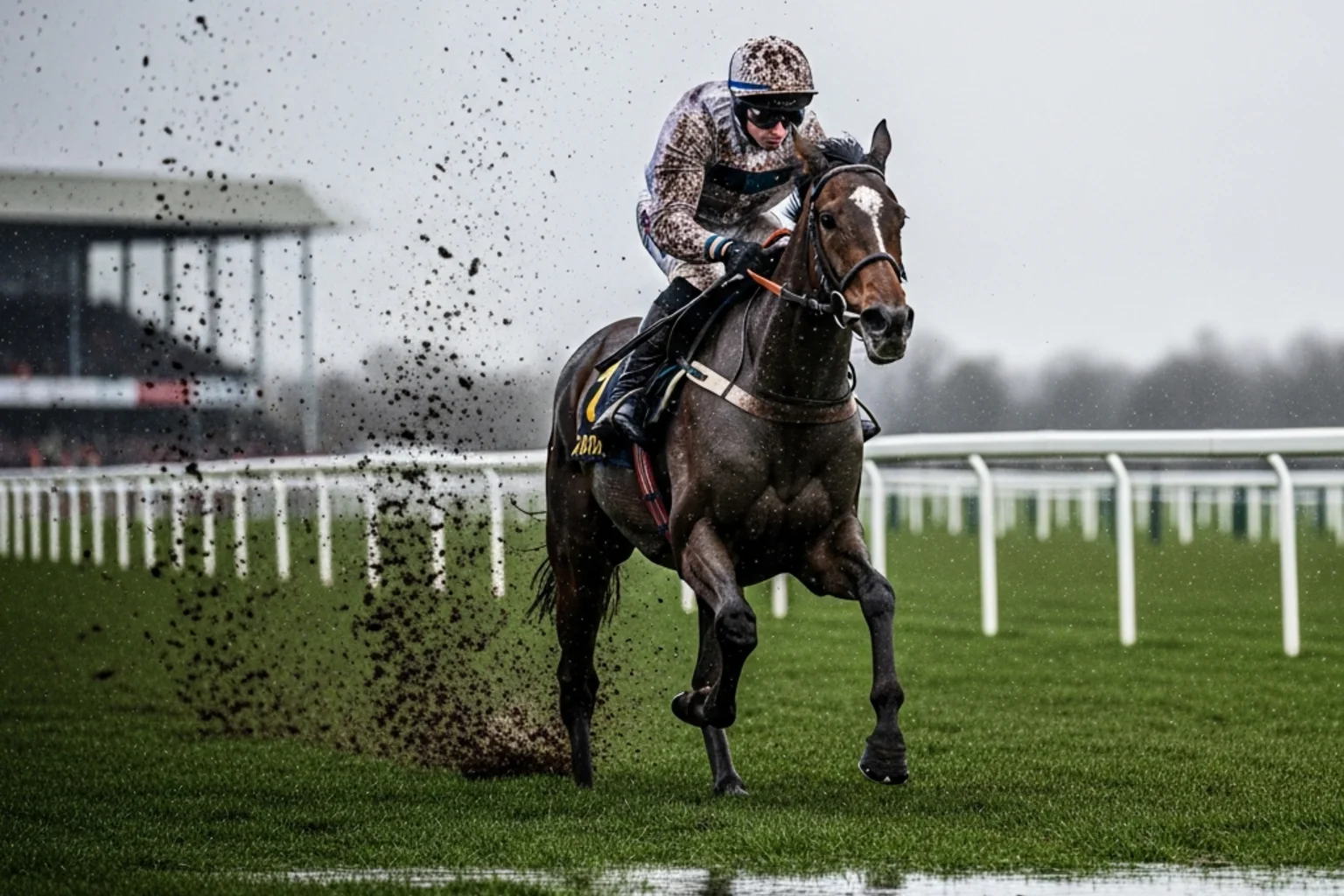
Ground conditions are the variable that ante-post bettors can least control and most often ignore. You can study form, track entries, monitor trainer quotes, and time your bet to perfection — then a week of rain turns good ground into heavy and your selection, a horse that barely stays on a sound surface, is running through treacle. In jump racing especially, where the going ranges from firm in early autumn to bottomless in midwinter, a ground-dependent ante-post bet is a bet with an extra dimension of risk that the odds rarely compensate for. Richard Wayman, the BHA’s Director of Racing, summarised the broader challenge facing the sport: “The horse population continues to decline and the betting environment remains challenging.” Ground conditions compound both problems — fewer horses means fewer alternatives when your selection does not handle the going, and a challenging betting environment punishes uninformed ante-post bets faster than ever.
The Going Scale
British racing classifies ground conditions on a standardised scale. For turf racing, the official descriptions run from hard (the firmest and rarest) through firm, good to firm, good, good to soft, soft, and heavy. All-weather surfaces at tracks like Kempton, Lingfield, and Wolverhampton use a separate scale: fast, standard to fast, standard, standard to slow, and slow. The going is assessed by the clerk of the course using a penetrometer — a device that measures how far a calibrated weight sinks into the turf — supplemented by visual inspection and local knowledge.
The going report is published on the morning of racing and updated throughout the day if conditions change. For ante-post purposes, the going on the day of the race is unknowable weeks or months in advance. What you can assess is the seasonal likelihood of particular conditions. A Cheltenham Festival in mid-March is far more likely to be soft or heavy than firm. A Royal Ascot in mid-June is far more likely to be good or good to firm. These baseline expectations form the first layer of ground analysis for any ante-post bet.
The scale matters because different horses perform vastly differently across it. A quick-actioned sprinter bred for speed on firm ground can lose lengths per furlong on heavy going. A strong-travelling stayer built for soft ground can pull up on firm. The gap between a horse’s best and worst running, depending solely on the ground, can be ten lengths or more over a three-mile chase. That gap can be the difference between winning and finishing mid-division — and it is completely invisible in form figures unless you dig deeper.
Seasonal Ground Patterns
British weather follows broad seasonal patterns that ante-post bettors can use as planning tools. The National Hunt season runs through winter, and the going at most UK tracks from November through March is predominantly soft or heavy. Cheltenham in particular has a reputation for testing ground in March, though the course’s excellent drainage system means it rarely reaches the extremes seen at other tracks. The Gold Cup has been run on ground ranging from good to heavy, but soft is the median expectation.
The flat season presents the opposite picture. From May through September, good to firm is the most common description, with periods of firm ground during dry summers. Royal Ascot in June typically races on good or good to firm, though unseasonal rain can turn it softer. York in August, Goodwood in late July — both tend towards faster ground, favouring horses with a turn of foot rather than stamina-laden mudlarks.
The transitional months — October and April — are the hardest to predict. October can produce anything from firm to soft depending on whether the summer’s residual dryness has held or the autumn rains have arrived. April is similarly variable. These months are when ante-post ground risk is highest, because the range of possible conditions is widest. The Gambling Commission’s survey data shows that participation in horse race betting nearly doubles from winter to spring — from 4% to 7% of the adult population — and the surge coincides with these transitional periods when getting the ground right becomes critical.
Identifying Ground Preferences
Every horse has a going preference, though some are more pronounced than others. The most reliable way to identify it is through form analysis: look at a horse’s record across different going descriptions and note where the performances cluster. A horse that has won three times on soft and finished out of the places on good to firm has a clear preference. A horse that performs consistently across all conditions is ground-versatile — a valuable trait for ante-post purposes because it removes one variable from the equation.
Pedigree offers secondary clues. Certain sire lines are associated with particular ground preferences. Offspring of stamina-oriented National Hunt sires often handle cut in the ground better than speed-oriented flat-bred types. On the flat, sires known for producing fast-ground performers — like Mehmas or Kodiac — are less likely to produce offspring that relish heavy going. These are tendencies, not certainties, but they help when assessing lightly raced horses with limited form on varying ground.
Trainer comments can also reveal ground preferences. A trainer telling the press “he wants a bit of ease in the ground” or “she needs it to dry out” is providing direct information. These quotes appear regularly in the Racing Post and on At The Races during the build-up to major meetings. Tracking them across a season builds a picture that the bare form figures alone might not reveal.
Why Going Amplifies Ante Post Risk
The going matters more in ante-post betting than in day-of-race betting for a simple reason: you cannot react to it. A punter betting on the morning of the race can check the going, see the forecast, watch the earlier races, and decide whether the conditions suit their selection. An ante-post punter who placed the bet three months ago has no such luxury. The bet is locked in, and the going on race day is whatever it turns out to be.
This amplification of risk is most acute in jump racing, where the going at the time of the bet (say, November) may bear no relation to the going at the time of the race (March). A winter with persistent rain produces heavy ground; a dry spell can leave it good. The BHA projects that Britain’s horse population will decline by 6–7% between 2024 and 2027, which will likely mean smaller fields at the lower levels. In smaller fields, the impact of one horse underperforming on unfavourable ground is magnified — there are fewer runners to absorb the surprise.
On the flat, the risk is somewhat lower because the seasonal going patterns are more predictable and the range of conditions narrower. But a freak weather event — a week of rain before Royal Ascot, a heatwave before York — can still catch ante-post bettors off guard. The flat season’s greater predictability is a relative advantage, not an absolute shield.
Mitigating Ground Risk
The first mitigation is selection. Whenever possible, back ground-versatile horses for ante-post bets. A horse that handles soft and good with equal facility removes the going variable entirely. These horses are rarer and often shorter-priced, but the reduced risk justifies the tighter odds.
The second is timing. Betting later in the ante-post cycle — when weather patterns for the race week are more forecastable — reduces ground uncertainty. A bet placed four days before Cheltenham, with the going already described as soft and rain forecast, is far better informed than one placed four months out. The trade-off is that the odds will be shorter, but the reduction in ground risk can make the shorter price better value in risk-adjusted terms.
The third is hedging. If you have backed a horse ante-post and the going forecast shifts against it, laying the selection on an exchange can limit the damage. The lay price will reflect the market’s assessment of the going impact, so you will not eliminate the loss entirely, but you can reduce it to a manageable level rather than riding the position into the ground — literally and figuratively. Ground conditions are the one ante-post variable that the market consistently underprices until the final few days before a race. If you are ahead of that repricing, the hedge will be cheap. If you are behind it, you are paying for insurance after the flood.
How Ground Conditions Affect Ante Post Decisions — More on this topic at ante post betting.
