
 Available in US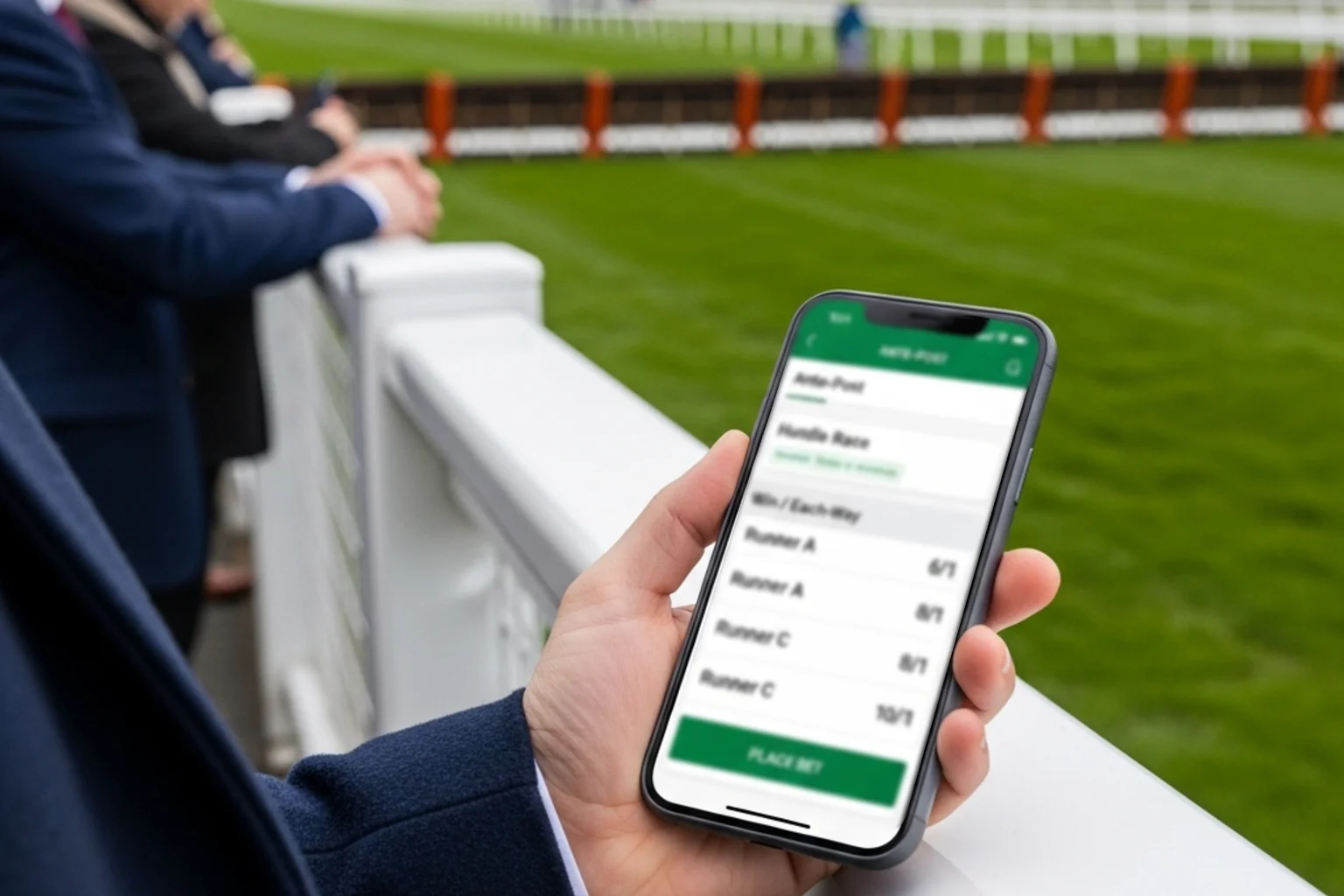
Ante-post betting used to require patience in the literal sense — posting a letter to your turf accountant days before a race, then waiting for the reply. Today the entire process happens on a screen you carry in your pocket. Over 80% of bets placed on the 2024 Cheltenham Festival were made via mobile devices, according to Flutter Entertainment data. That figure is not unique to Cheltenham. Mobile now dominates every form of horse racing betting, and ante-post is no exception. What has changed is not just convenience but capability: the modern betting app can alert you to market moves, display NRNB windows, execute cash-outs, and compare odds across operators — all from the train, the pub, or the sofa.
The Mobile Shift: 80%+
The shift to mobile has been comprehensive rather than gradual. A decade ago, desktop was the primary channel for online betting. By 2020, mobile had overtaken it. By 2024, the dominance was overwhelming. The Gambling Commission’s industry statistics reported 24.4 million active accounts across remote betting and gaming operators at the end of the most recent quarter — the vast majority accessed primarily through apps.
For ante-post specifically, mobile has removed the friction that once slowed decision-making. When a horse wins a trial race at Haydock on a Saturday afternoon and you want to back it ante-post for Cheltenham, you no longer need to find a computer or call a telephone betting line. The bet can be placed within seconds of the result, before the market fully adjusts. That speed is a genuine advantage. Ante-post prices after a trial win move fast — sometimes within minutes — and mobile access means you can act in the window before the new consensus price forms.
The flip side is that mobile makes impulsive betting easier. The same frictionless experience that lets you capture a post-trial price also lets you place a half-considered punt on a horse you saw mentioned on social media. Ante-post discipline — research, timing, bankroll management — is harder to maintain when the bet is always one tap away. The technology is neutral. How you use it is not.
Key App Features
Not all bookmaker apps are equally suited to ante-post betting. The features that matter most for managing positions over weeks and months are often different from those that matter for day-of-race punters.
Bet tracking is essential. A good app displays your open ante-post bets with the original odds alongside the current market price, giving you a real-time view of whether each position is in profit or loss. Some apps do this well — bet365 and Paddy Power both offer clear portfolio views. Others bury open bets in a history tab that requires scrolling and does not display live market prices.
Market navigation matters too. Ante-post markets are typically nested under a “Future Racing” or “Ante-Post” tab within the horse racing section. If that tab is hard to find, or if the markets within it are poorly organised — mixing different meetings and different race types without clear hierarchy — the app is working against you. The best apps group ante-post markets by meeting (Cheltenham, Aintree, Royal Ascot) and then by individual race, with clear labels showing whether NRNB is active.
Odds comparison is increasingly built into apps, though it remains less developed than on dedicated comparison sites like Oddschecker. Some operators highlight when their price is best in market — useful for ante-post where price variation between bookmakers is wider than on race-day markets.
Setting Alerts for Moves and NRNB
Push notifications are one of mobile’s genuine contributions to ante-post strategy. Most major bookmaker apps allow you to set alerts on specific horses or races. When the price moves beyond a threshold — say, your horse shortens from 12/1 to 10/1 — the app sends a notification. This is far more efficient than manually checking prices every day across multiple operators.
The more valuable alert, for ante-post purposes, is the NRNB notification. When a bookmaker activates Non-Runner No Bet on a particular market, punters with price alerts or followed selections will typically receive a push notification. This is the trigger to reassess existing unprotected bets or to place new bets within the NRNB window. Missing the NRNB activation — because you were not checking prices that week — can mean the difference between a refundable wager and an unprotected one.
A practical setup: follow your target horses and races across two or three bookmaker apps. Set price-movement alerts on each. When one app notifies you of a significant move or an NRNB activation, cross-reference the price across the others before placing. This takes seconds on a phone and is impractical on any other platform.
In-App Cash Out
Cash out on ante-post bets — where available — is overwhelmingly a mobile feature. The ability to lock in a profit (or cut a loss) on an open ante-post position, at any time, from anywhere, is a capability that simply did not exist for ante-post bettors before mobile apps became mainstream.
The mechanics are simple: open your bet slip, find the ante-post bet, and if a cash-out value is displayed, you can accept it with a single tap. Partial cash out — settling a percentage of the bet while leaving the rest active — is available on some apps and allows you to bank a portion of profit while maintaining upside. The cash-out values update in real time as the market moves, though during periods of high volatility — after a trial race, for example — the offer may be temporarily suspended.
One caution: cash-out values on mobile are calculated with the same bookmaker margin as on desktop. The convenience of one-tap cash out does not change the economics. You are still accepting a price below the theoretical fair value of your position. The ease of the transaction can make it tempting to cash out too early or too often. Treat the cash-out button as a tool, not a reflex.
What to Look for in an App
When evaluating a bookmaker app for ante-post use, prioritise these attributes: clear ante-post market organisation, live odds alongside your open bets, push notification controls for price moves and NRNB, functioning cash out on ante-post markets, and fast load times for market pages. An app that is slick for in-play football betting but buries its ante-post markets under three submenus is not built for your needs.
Consider running two or three apps simultaneously. The ante-post bettor who shops across operators for the best price — a practice that has always been good discipline — can do so on mobile in seconds. Having multiple apps also provides redundancy: if one operator pulls cash out on a particular market, another may still offer it. The marginal effort of maintaining two or three accounts is small relative to the flexibility it provides across a six-month ante-post season.
One final consideration: battery life and connectivity. It sounds mundane, but ante-post decisions made at racecourses, in areas with poor signal, or on a phone at 3% battery have a way of going wrong. If you are at a trial meeting and want to place an ante-post bet immediately after a result, make sure you have the practical infrastructure to execute. A missed price because your phone died is a peculiarly modern form of ante-post misfortune, and an entirely avoidable one.
Mobile Betting and Ante Post — More on this topic at ante post betting.
