
The best sites for betting on greyhound racing
Loading...
- Do Favourites Win the Grand National?
- Grand National Ante Post Market Timeline
- Weight and Age: What the Data Shows
- Course Specialists: Reading the Fences
- Non-Runner No Bet for the Grand National
- Prep Races That Shape the Market
- Hedging Your Grand National Ante Post Bet
- Case Studies: Wins and Losses at Aintree
- Building Your Grand National Ante Post Approach
The Grand National is the one horse race that the entire country watches. An estimated £250 million was wagered on the 2025 renewal — more than any other single race in British sport. It is also the race that most consistently defies the ante-post market. The favourite has won just 15.4% of the time across the race’s 175-plus year history, and the average winning odds sit around 20/1. If there is a single race that rewards the ante-post bettor willing to think differently about value, risk, and timing, this is it.
Grand National ante-post betting is not like backing a horse for the Cheltenham Gold Cup. The Gold Cup is a Grade 1 championship race where the best horse usually wins. The National is a four-mile handicap chase over thirty unique fences where stamina, jumping ability, temperament, and luck all play a role — and where the form book is a guide rather than a gospel. This guide breaks down the data, the market timeline, the trends, and the strategies that the most effective National ante-post bettors use.
Do Favourites Win the Grand National?
Rarely. The historical record is clear. Across the race’s entire history, only 27 favourites have won from 175-plus renewals — a strike rate of 15.4%. Over the last twenty years, the figure improves slightly to approximately 20%, with favourites winning in 2024 (I Am Maximus at 7/1), 2023 (Corach Rambler at 8/1), 2019 (Tiger Roll at 4/1), and 2010 (Don’t Push It at 10/1).
The average winning odds tell a complementary story. According to Racing Post analysis, the average price of a Grand National winner is approximately 20/1, and 25 of the last 30 winners returned at double-figure odds. The most extreme example in modern times was Mon Mome, who won at 100/1 in 2009 — but even excluding that outlier, the typical winner comes from the 10/1 to 25/1 range of the market, not from the head.
What does this mean for the ante-post bettor? It means that backing the favourite for the Grand National is a losing strategy over time. A 20% strike rate at an average favourite price of roughly 7/1 produces a negative return on investment. The value lies further down the market — in horses whose profiles match the race’s specific demands but whose prices reflect general class assessments rather than Aintree suitability. The National rewards specialists, and the ante-post market does not always price them accordingly.
Grand National Ante Post Market Timeline
The Grand National ante-post market opens immediately after the previous year’s race in April and builds momentum through three distinct phases.
The initial phase, from April to December, is speculative. Bookmakers price up a long list of potential contenders — fifty or more — at wide odds. The market is driven by reputation, previous National form, and the early-season results that suggest a horse might be pointed towards Aintree. During this phase, the prices are at their widest, but the information quality is lowest. Backing a horse in June for the following April’s National is a nine-month commitment with no NRNB protection and no certainty that the horse will even be entered.
The second phase begins with the publication of entries in late January. The handicapper assigns weights, and the market adjusts to the confirmed field. This is the moment when the ante-post market transitions from speculation to analysis. You now know which horses are entered, what weights they carry, and — critically — which trainers have committed to the Aintree route by making an entry. Horses that are not entered at this stage are, by definition, not running, and any ante-post bets on them are lost.
The third phase runs from entries to final declarations, roughly a two-month window. During this period, forfeit stages — where trainers must pay to keep their horse in the race — progressively thin the field from over a hundred entries to the final forty runners. Prep races at Cheltenham, Haydock, and Aintree itself provide the last pieces of form evidence. NRNB offers typically activate four to six weeks before the race, and the market enters its final shape.
The post-Cheltenham window is particularly active. Results at the Festival — especially in the staying handicap chases and the Cross Country — feed directly into the National market. A horse that wins impressively at Cheltenham will shorten for the National overnight. A horse that falls or is pulled up will drift. The three weeks between Cheltenham and the National are, for many ante-post bettors, the optimal entry window: sufficient form evidence, NRNB usually active, and prices that still offer value relative to the starting price.
Weight and Age: What the Data Shows
Two factors dominate Grand National trend analysis: the weight a horse carries and its age. The data from the last decade is remarkably consistent.
Weight is the primary filter. Only three winners in the last ten Grand Nationals carried more than 10st 13lb. They were I Am Maximus in 2024 (11st 6lb), Tiger Roll in 2019 (11st 5lb), and Many Clouds in 2015 (11st 9lb). All three were exceptional horses — Gold Cup or championship-level performers who overcame the burden of a high weight through sheer class. For the ante-post bettor seeking value rather than backing a superstar, the sweet spot is in the 10st 2lb to 10st 12lb range — horses with enough ability to compete but not enough weight to anchor them.
Age shows a similarly clear pattern. Eight of the last ten winners were aged eight or nine. The outliers were Noble Yeats (seven) in 2022 and Pineau De Re (eleven) in 2014. The eight-to-nine age range represents the peak of a staying chaser’s career — experienced enough to handle the unique demands of the Aintree fences, fit enough to sustain four miles of jumping, and seasoned enough to cope with the atmosphere and the scale of the event.
The intersection of these two trends defines the prototype Grand National winner: an eight- or nine-year-old carrying between 10st 2lb and 10st 12lb, with proven stamina over three miles or more and ideally some previous experience of the Aintree fences. Finding that horse in the ante-post market, at a price that reflects its actual chance rather than its general rating, is the core task.
There are secondary filters that sharpen the picture further. Horses that have completed the National course before — whether in the race itself, the Becher Chase, or the Topham — have demonstrated the ability to handle the fences and the distance. Previous course form is one of the most reliable positive indicators in a race where the unknowns are vast. A horse making its Grand National debut is, by definition, unproven over the unique demands of the course. That uncertainty should be reflected in how you weight its ante-post credentials against a horse that has already negotiated Becher’s Brook and the Canal Turn and come home safe.
Course Specialists: Reading the Fences
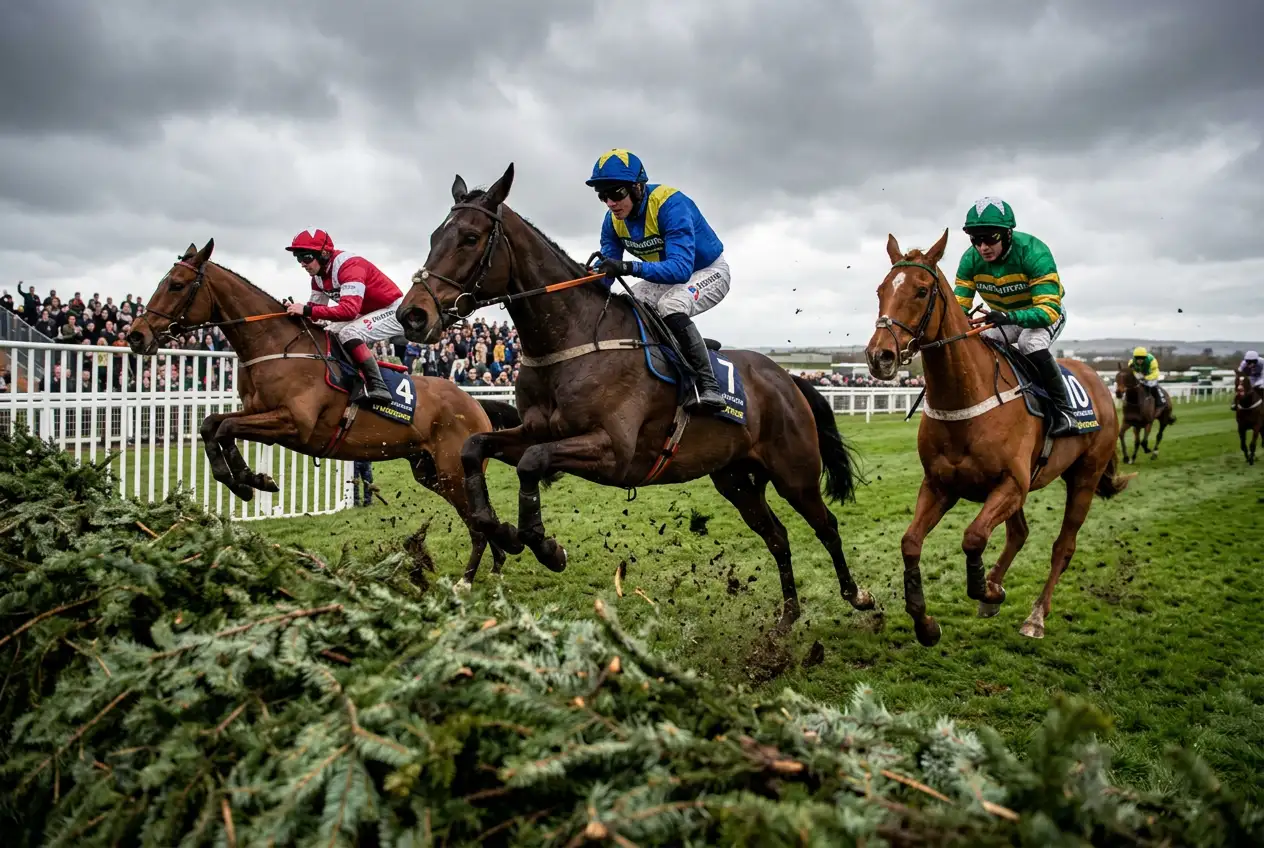
Aintree’s Grand National fences are unique in British racing. Made of spruce rather than the birch used at other courses, they present a different visual and physical challenge. There are thirty obstacles over two circuits — fourteen jumped twice, plus The Chair and the Water Jump, each taken once. Becher’s Brook, with its steep landing side, and the Canal Turn, where horses must negotiate a sharp left-hand bend immediately after jumping, are the most famous and the most demanding.
Course experience is one of the strongest positive indicators for the Grand National. A horse that has completed the course before — whether in the National itself, the Becher Chase in December, or the Topham Chase — has demonstrated the ability to handle the unique fences, the distance, and the atmosphere. Tiger Roll’s consecutive victories in 2018 and 2019 were built, in part, on course familiarity developed over multiple runs at Aintree.
For the ante-post bettor, course form is a more reliable filter than class. A horse rated 150 that has never seen the Aintree fences is a less appealing ante-post proposition than a horse rated 140 that finished in the first ten in the previous year’s National. The fences are the great leveller — they reduce the relevance of pure ability and elevate the relevance of jumping technique, temperament, and experience. Prioritise these factors over official ratings when assessing ante-post contenders.
Temperament is harder to quantify but equally important. The Grand National is run in front of approximately 60,000 spectators. The parade ring, the walk to the start, and the first-fence melee are sensory experiences that some horses handle and others do not. A horse that is known to be keen, anxious, or easily distracted may waste energy before the race even begins. Previous racecourse behaviour — particularly at large, noisy festivals — is a data point worth including in your ante-post analysis.
Non-Runner No Bet for the Grand National
The Grand National is one of the races most commonly covered by NRNB offers. Most major bookmakers activate NRNB four to six weeks before the race, typically after the Cheltenham Festival when the post-Festival market has settled and the final forfeit stages are approaching.
The NRNB window for the National is particularly important because the field is large and the attrition rate between entries and final declarations is high. Over a hundred horses may be entered in January, but only forty will line up in April. The probability of any individual horse being a non-runner is higher in the National than in almost any other race — which makes NRNB protection correspondingly more valuable.
There is a specific Grand National scenario to be aware of: balloting. If more than forty horses are declared, some will be balloted out — removed from the field by the handicapper based on their weight allocation. Ante-post bets on balloted-out horses are void: the stake is returned. This is one of the few circumstances where the standard “non-runner = lost stake” rule does not apply, because balloting is imposed by the race organisers rather than initiated by the horse’s connections.
Prep Races That Shape the Market
The Grand National does not exist in isolation. A network of prep races provides the form evidence that the ante-post market digests. Knowing which races to watch — and how their results translate to Aintree — is a core strategic skill.
The Becher Chase at Aintree in December is the most direct prep. Run over the National fences (albeit over a shorter distance of three miles two furlongs), it tests a horse’s ability to handle the unique obstacles. A strong Becher Chase performance is one of the best positive indicators for the National itself, and the ante-post market responds accordingly.
The Grand National Trial at Haydock in February is a three-mile-four-furlong handicap chase that has produced several subsequent National winners. Its timing — roughly eight weeks before the National — makes it a useful mid-range form reference. The Welsh Grand National at Chepstow (December/January) and the Midlands National at Uttoxeter (March) test stamina over extreme distances and provide evidence of a horse’s ability to stay beyond three miles.
The Cheltenham Festival, while not a National prep in the traditional sense, has a major indirect influence. Horses that run well in Cheltenham’s staying handicap chases — the Ultima, the National Hunt Chase, the Plate — often head to Aintree with enhanced reputations and shortened prices. Conversely, a disappointing Cheltenham run can cause a horse to drift in the National market, creating a potential value opportunity for the punter who believes the Festival form is misleading.
The Scottish and Irish Grand Nationals — run in the weeks after Aintree — do not serve as prep races in the conventional sense, but their ante-post markets are shaped by the National’s results. A horse that ran well at Aintree without winning may be an attractive ante-post proposition for the Scottish or Irish equivalents.
Hedging Your Grand National Ante Post Bet
The Grand National is one of the best races for ante-post hedging, because the odds movement between early backing and race day can be dramatic. A horse backed at 33/1 in November might be 10/1 by April — a threefold compression that creates a hedging opportunity on a betting exchange.
The mechanics: suppose you backed a horse with £20 at 33/1. If the horse is now 10/1 on Betfair, where average matched volume on UK races runs around £500,000 and much higher for the National, you can lay the horse at 10/1 for a stake that locks in a profit. A lay of approximately £60 at 10/1 would produce a guaranteed profit of roughly £100 regardless of whether the horse wins or loses — though the exact figures depend on exchange commission and the precision of your calculations.
The decision to hedge is personal. If you backed the horse because you believed it was a genuine contender and the trial form has confirmed your thesis, holding the full position may be correct — the value that drove the original bet may still be present even at the shorter price. If the horse has shortened primarily due to market hype or media attention rather than new form evidence, hedging captures the paper profit before the market potentially corrects.
One caveat: exchange liquidity on Grand National ante-post markets can be patchy until the final two weeks before the race. Laying a horse at a specific price requires someone on the other side of the bet to match your order. In the months before the race, the exchange market for mid-range contenders may be thin enough that your lay order sits unmatched. Plan your hedging for the period after the final forfeit stage, when the market is most liquid.
Case Studies: Wins and Losses at Aintree
The Grand National’s history is rich with ante-post lessons — both triumphant and painful.
I Am Maximus won the 2024 National at 7/1 — a relatively short price by the race’s standards. But punters who had backed him ante-post in the autumn, when he was available at 16/1 or wider, collected at more than double the starting price. The horse fitted the profile: nine years old, carried 11st 6lb (heavy, but he had the class to overcome it), trained by Willie Mullins, and ridden by Paul Townend. His Cheltenham form in the preceding weeks confirmed his well-being. The ante-post bet was validated by the trial evidence, and the early price rewarded the conviction.
Mon Mome’s 100/1 victory in 2009 is the ultimate outsider story. The horse had won the Becher Chase at Aintree the previous December — the most direct course form available — and was a proven stayer on soft ground. The 100/1 price reflected a class assessment that deemed him insufficiently talented, but the race-specific profile was strong. An ante-post bettor who had noted the Becher Chase form and the staying credentials could have backed Mon Mome at prices that no post-trial shortening would have eroded, because the market never took him seriously.
On the losing side, the 2025 season provided a stark reminder of non-runner risk. Several high-profile Grand National contenders were withdrawn in the weeks before the race after injury setbacks — their ante-post stakes lost without a run. Brant Dunshea, the BHA’s Acting Chief Executive, described the wider context: “British racing has repeatedly warned of the unintended consequences of well-meaning policy decisions on our sport, including the threat of inadvertently growing unlicensed market activity.” For the individual punter, the unintended consequence was simpler — months of waiting, money frozen, and nothing to show for it.
The case studies share a common thread: the horses that reward ante-post bettors in the National are those whose profile — age, weight, course experience, stamina — matches the race’s unique demands. The horses that cost ante-post bettors are those backed on reputation rather than suitability, or those whose connections changed plans before the race. Fit the profile first. Then check the price.
Building Your Grand National Ante Post Approach
A structured approach to Grand National ante-post betting follows five steps. First, define the profile. Weight under 11st. Age eight or nine. Proven stamina over three miles or more. Ideally, previous experience of the Aintree fences. Solid jumping record — a horse that falls frequently is a liability over thirty unique obstacles in a field of forty.
Second, identify the candidates. Once entries are published in late January, filter the list against the profile. You will typically find eight to twelve horses that fit the criteria. Compare their ante-post prices across multiple bookmakers to spot the widest available odds.
Third, watch the preps. The Becher Chase, the Haydock Trial, the Welsh National, and the Cheltenham Festival all provide form updates. After each prep, reassess your candidates. Has the thesis been confirmed or contradicted? Has the price moved?
Fourth, time the bet. If NRNB is active — typically from late February or early March — back within the protected window. If you are acting earlier, size the stake conservatively to account for the non-runner risk. Consider backing two or three horses at small stakes rather than one horse at a larger stake. Diversification matters more in the National than in almost any other race, because the non-runner risk and the unpredictability of the event are both unusually high.
Fifth, manage the position. As the race approaches, monitor the odds. If a selection has shortened significantly, consider hedging on an exchange to lock in a portion of the paper profit. If a selection has drifted and the form no longer supports the thesis, accept the loss and move on. The Grand National will be run next year too. The bankroll you protect today funds the ante-post bets of tomorrow.
One additional consideration: the Grand National is the single most popular betting race among casual punters. Many of those punters — office sweepstakes, once-a-year flutter on a name they like — are backing horses with little regard for form, weight, or course suitability. Their money distorts the market, shortening the prices on household names and leaving the well-handicapped course specialists at longer odds than they deserve. The disciplined ante-post bettor can exploit this distortion by focusing on the profile rather than the narrative. Let the casual money chase Tiger Roll’s successor. You back the eight-year-old on 10st 7lb that won the Becher Chase last December and that nobody at the office has heard of.